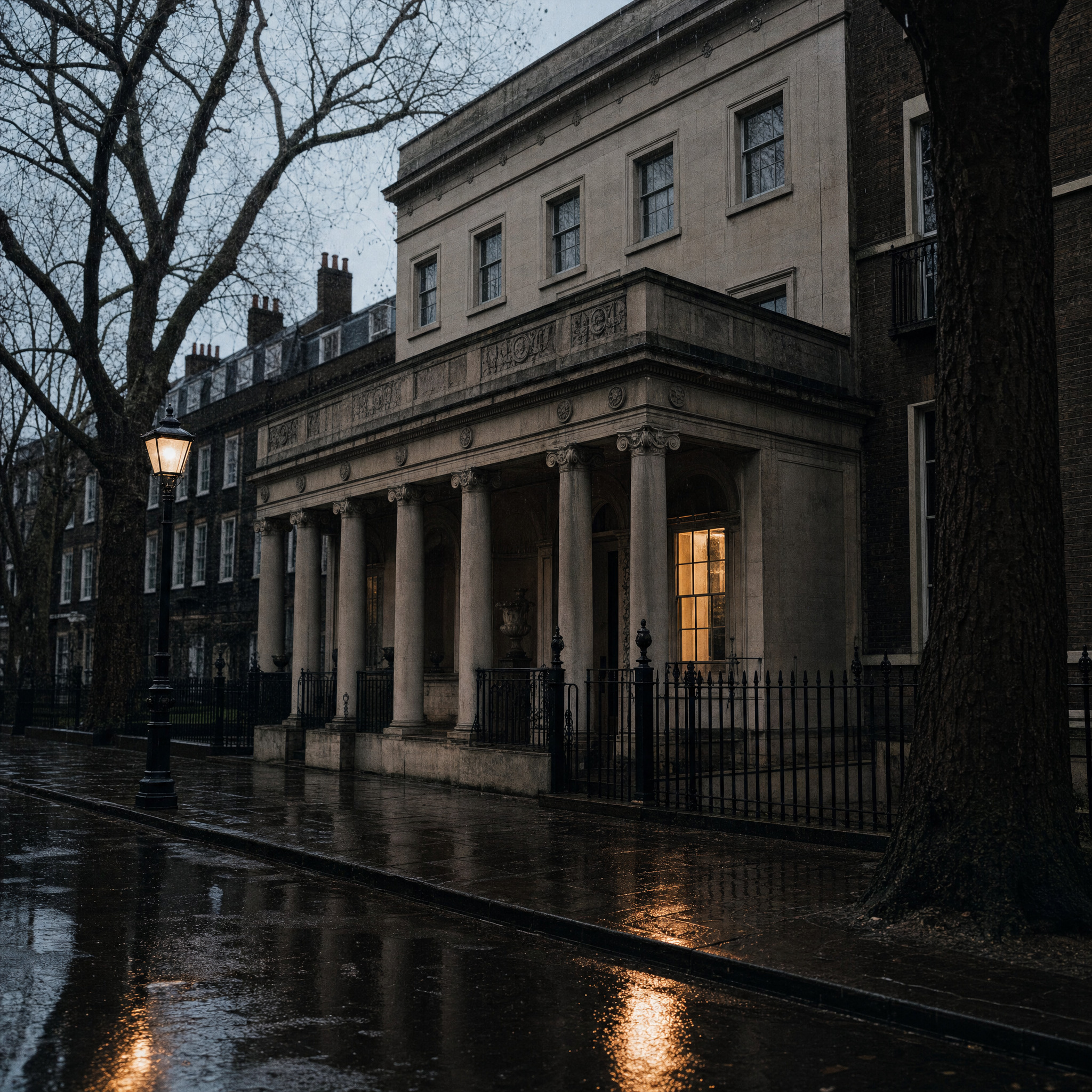
I went the first time on a Tuesday in the rain, on the calculated theory that weather thins a crowd. It does not. It only makes the crowd wetter and rather more determined, and by six o'clock there were forty of us pressed along the railings of Lincoln's Inn Fields under umbrellas that kept catching one another, all of us pretending we had simply happened to be passing. I have made the same calculation on three subsequent visits. It has failed every time. I intend to keep making it.
There is a reason the theory is worth persisting with, and it is not optimism. It is that the house is small, the rooms are narrow, and the number of people admitted at once has to be kept low or the whole arrangement would be trampled into dust inside a decade. Whatever the weather, the building is at capacity, because capacity is about twelve people in a room the size of a decent pantry. Rain does not reduce the crowd. It reduces the crowd's confidence, which is nearly as useful.
I. A house assembled out of disagreements
Most museums are one idea, repeated until the visitor submits. Number 13 Lincoln's Inn Fields is not one idea. It is thirty years of an architect buying the house next door, pulling it about, changing his mind, and leaving both the change and the mind visible. Soane took three terraced houses along the north side of the Fields and worked them into each other over the length of a career, so that the plan you are walking through is not a plan at all but a sequence of decisions taken decades apart by a man who kept getting better and kept getting stranger.
Then, in 1833, he did the thing that turns an eccentricity into an argument. He obtained a private Act of Parliament settling the house and everything in it on the nation, on the condition that it be kept substantially as he left it. Not conserved in spirit. Kept. The consequence is that nobody has ever been allowed to tidy the place, and tidying is precisely what every subsequent generation would have wanted to do. Every crowded shelf you resent is a shelf a curator has been legally prevented from thinning on your behalf.
This is why the house argues. A tidied collection agrees with you: it has already made the selections, drawn the conclusions, and written the label. Soane's house has made no selections. It hands you eleven things at once and declines to say which of them matters. You are obliged to have an opinion, and then the next room disagrees with the opinion you have just had.
II. The argument he framed and hung up
In September 1815 two anonymous pieces appeared in a newspaper called The Champion, attacking Soane's architecture with the particular viciousness available only to somebody who knows exactly where a man is thin-skinned. They were written by his younger son, George, lately of the debtors' prison. Soane's wife Eliza was shown them on 13 October and is recorded as saying that George had given her her death blow. She died six weeks later.
Her obituary put the cause as a burst gall bladder, and I think we are obliged to believe the obituary. Soane did not. He had the two articles framed, hung them in his own house, and labelled them the death blows given by George Soane. He then spent the remaining twenty-two years of his life walking past them.
I have stood in front of that arrangement in three different moods and got a different answer each time. It is grotesque. It is also the single most honest object in any house museum I know. Most people hide the letter. He glazed it, hung it at eye level, and made his grief part of the fabric of the collection — which, given the Act of Parliament, means he made it permanent. The man who could not stop rearranging his house arranged that, too, and then locked it.
He did not merely keep the thing that wounded him. He hung it, and then made it illegal to take down.
Everybody arrives at this house expecting genius and finds it. Rather fewer are ready for the grievance. It is worth knowing before you go, because once you have seen it you understand what all the mirrors and shafts and hidden skylights are actually for. They are not tricks. They are the work of a man determined that the interior should be more interesting than whatever was being said about him outside.
III. What to do with your eyes, in order
Everyone will tell you about the Picture Room, and everyone is right: the walls are hinged planes that swing open to reveal a second layer of paintings, and then open again to reveal a third and a small balcony over the void beyond. Let the attendant work them. Do not read ahead about what is behind the second set; the pleasure is entirely in the sequence and you can only be surprised once. Then, when it is over and the room is applauding in the restrained English manner, notice that you have been standing in a cupboard.
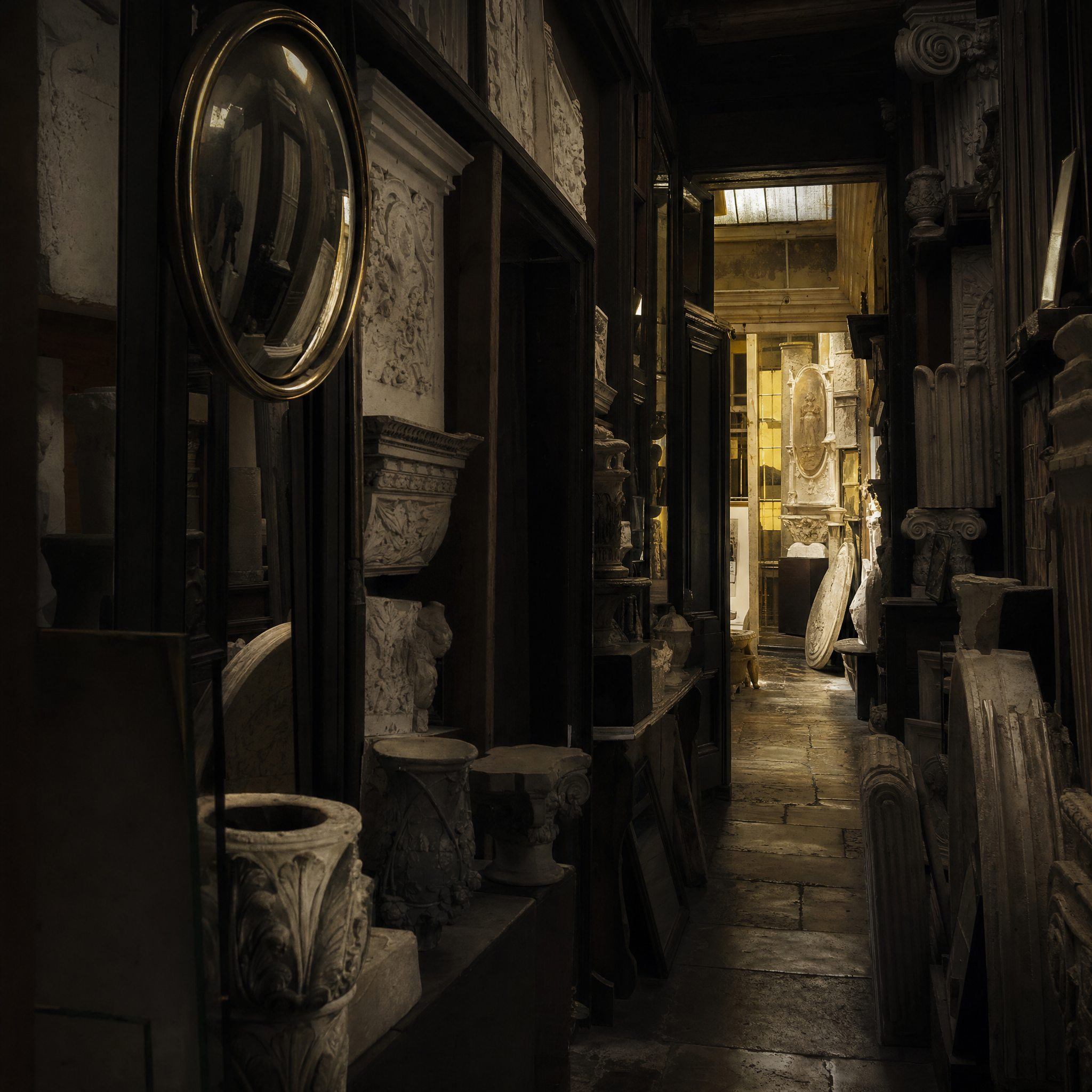
The thing worth going back for is duller to describe and better to be in. It is the corridors. Soane understood that a room only lands if you have been compressed first, so the passages between his set pieces are narrow, low, crowded to the ceiling with casts, and deliberately dim. You go through a tight dark space full of somebody else's marble elbows, and then the breakfast room opens above you with its shallow canopy of a dome floating on nothing you can locate, and the effect is not architecture, it is timing. Stand directly beneath it and look for the edge of the dome. There isn't one you can honestly point at.
He is also stealing light throughout, from rooms you cannot see and floors you are not on, through shafts, borrowed lights and coloured glass that turns a grey London afternoon a convincing shade of Italy. Mirrors are set where you do not expect them, at angles chosen to lengthen a wall or hand a scrap of daylight down two storeys. Half the time you cannot tell whether you are looking at a room or at a reflection of one, which on a bad day is irritating and on a good day is the whole point. I have written elsewhere about what six low sources do that one high source cannot; Soane got there in 1812, working with daylight and candle, and nobody has improved on him with a lighting plan since.
IV. The sarcophagus, and the correct way to show off
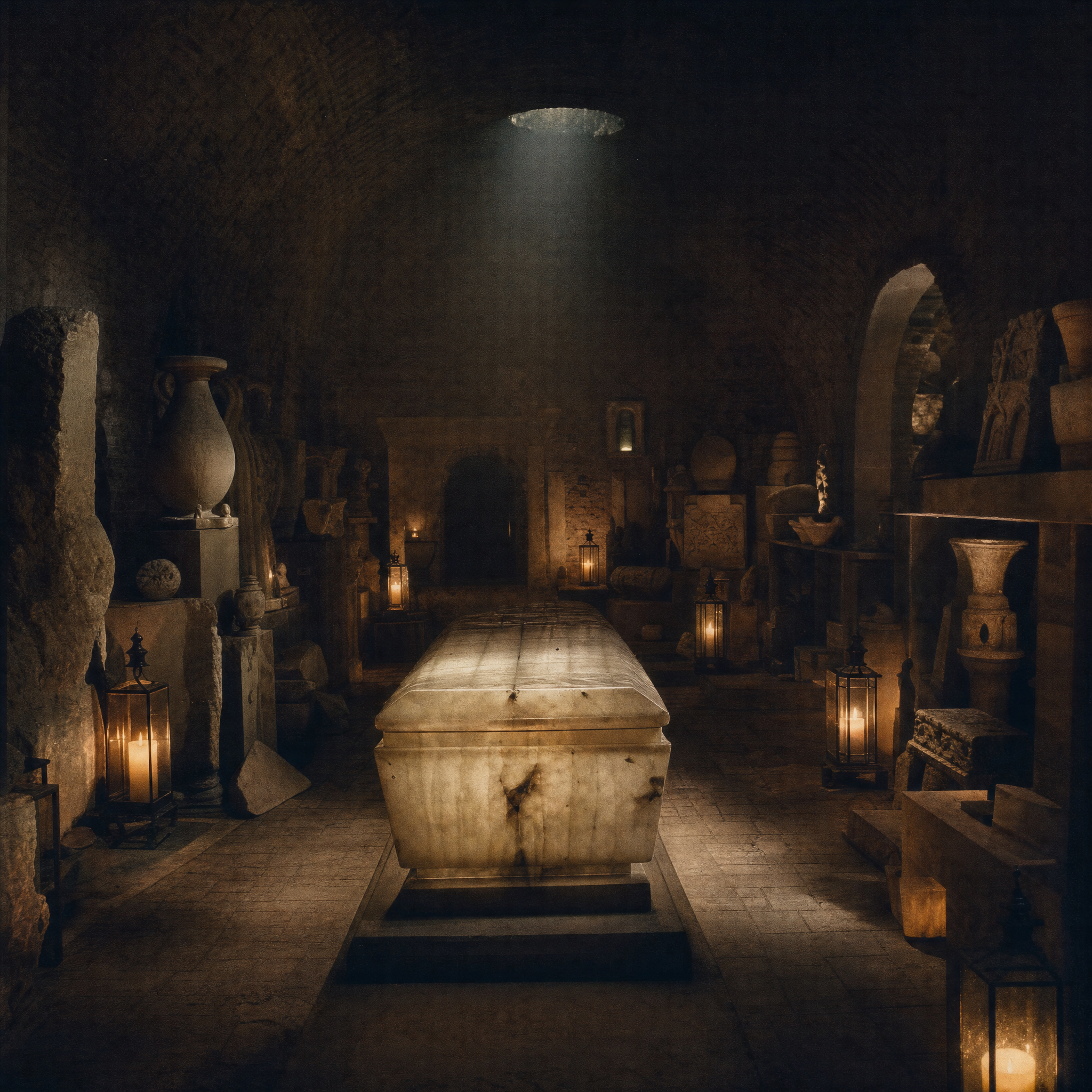
In 1824 the trustees of the British Museum decided that the alabaster sarcophagus of Seti I was more than they cared to spend. Soane paid the two thousand pounds and put it in his basement, where it remains, glowing faintly under a shaft of light in a chamber arranged by a man plainly enjoying himself. The following year he held three evening parties to show it, invited most of literary and political London, and — this is the part I find irresistible — supervised the lighting himself, lamp by lamp, so that the shadows fell where he wanted them.
I think about those three evenings more than is reasonable. It is the moment the house stops being a collection and becomes a performance with a fixed lighting state, and it explains why daylight in these rooms always feels like a compromise everyone has politely agreed to. If you can get a place on a candlelit evening, take it, and go alone. By day the house is an inventory. By candle it is a set of decisions, and you can see which ones he was proud of.
There is a courtyard, too, with a monk's parlour attached to it, built for a fictitious medieval hermit called Padre Giovanni whom Soane invented and then rather came to inhabit. Padre Giovanni has a grave out there. Beside it stands a monument to Fanny, Mrs Soane's dog. A serious man, a great architect, a wrecked family, and a headstone for a lapdog, all inside forty feet. I do not know a better argument for going to look at houses instead of reading about them.
V. Go when it is empty; it never is
A confession the title requires. My Tuesdays are a fossil. For years the house opened Tuesday to Saturday, with a late candlelit opening on the first Tuesday of the month, and that is the rhythm my habits were formed by. It opens Wednesday to Sunday now, and a person who turns up on a wet Tuesday with a folded umbrella and a plan will be looking at a shut door and a very handsome stone front. I have kept the title because the title is what happened, and because I would like you to check the days before you cross London rather than after. The practical facts live on the directory plate for the house, and the museum's own site is the only source worth trusting on the week you actually intend to go.
The rest of the advice is unglamorous and works. Arrive for opening and be first through the door, because the first forty minutes are the only forty minutes in which you will be able to stand still. Allow two hours; four is not excessive and I have never once left early. Photography is allowed, which surprises people; filming is not, and nor is flash, nor a tripod, nor a selfie stick, nor a camera large enough to swing. Take the museum at its word on the second point — a flash in these rooms destroys the one thing you came for. There is no tearoom. Have your lunch first, and treat the absence as part of the discipline, which is what I have decided to do about it.
And go twice. The first visit is spent being astonished, which is enjoyable and slightly useless. The second is when you start noticing the seams — where one house was joined to the next, where the money and the patience ran thin, where a thing was moved and the shadow of its old position stayed behind. Reading those seams in my own house is its own subject — the drawings and the building disagree in exactly the same dialect. If you want the second half of the argument, Soane's other house at Pitzhanger, in Ealing, is where he was rehearsing. Go there afterwards. It explains the first one and diminishes it not at all.
I have been four times, most recently in March, and I have not yet had the last word. That is the recommendation. Nearly every house museum in the directory is a settlement — a life arranged after the fact by people being tactful on the owner's behalf. This one was arranged by the owner, in advance, against the tact of everybody who came after, and it is still winning. Take the umbrella. The queue is part of it.

Bea is a curator and writer, and keeps the Museum Directory. She has still not seen the Picture Room walls opened without at least one person filming it in a pocket, which is the one thing the house asks you not to do.
Opening days, admission and evening bookings change. Everything practical here was true when written and is worth checking against the museum's own site before you travel; the plates on this page are made images, not photographs of the house.