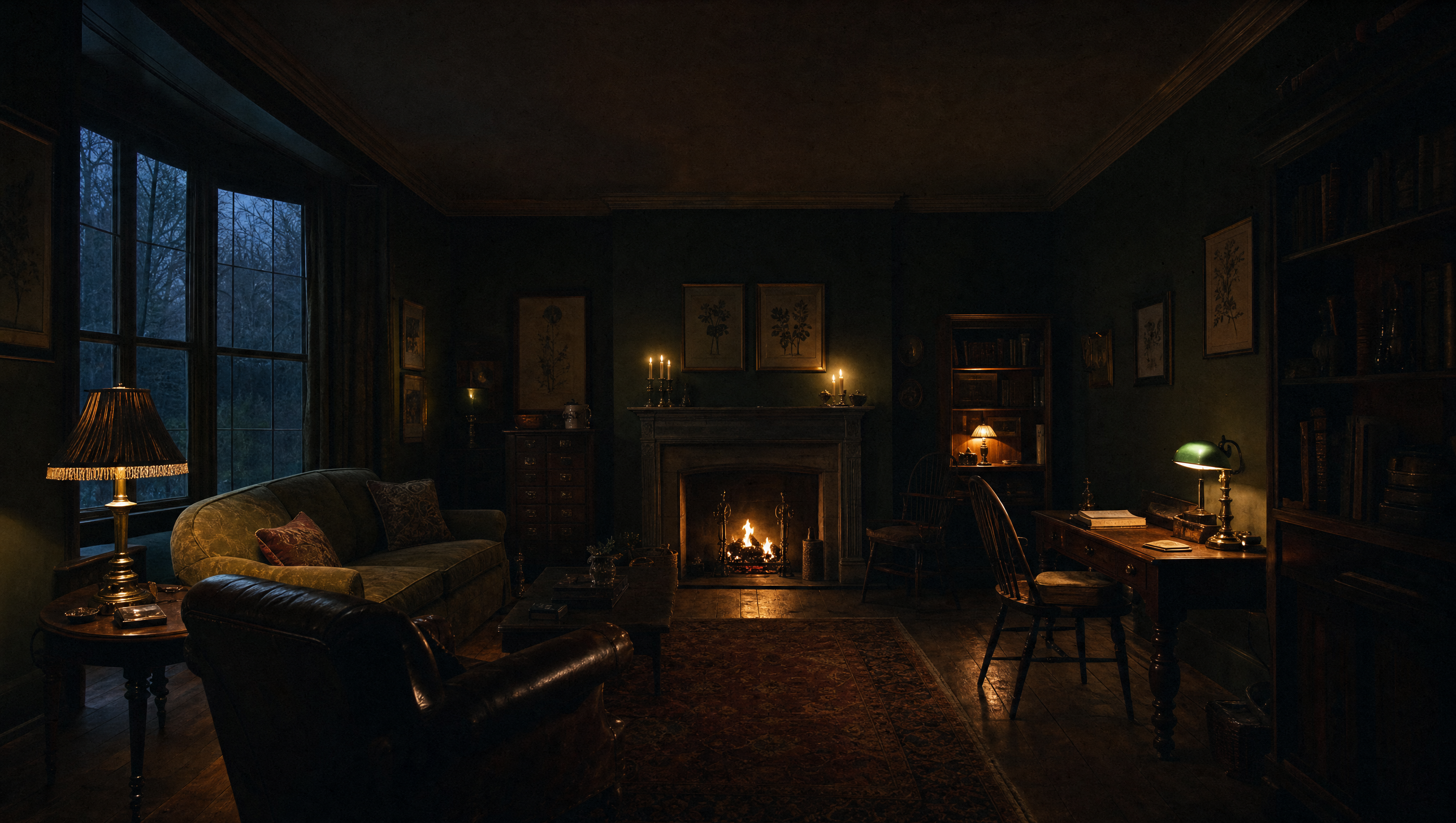
The overhead light in this room has been switched on four times since I came to the house, and two of those were to find an earring. It is not a bad fitting. It is brass, it is early, it was converted from gas by somebody competent, and it hangs from a plaster rose the size of a dinner plate. I have no quarrel with the object. My quarrel is with the assumption underneath it — that the correct place for the light in a room is the middle of the ceiling, and that everything else is decoration.
That assumption is about a hundred years old, it came from a pipe, and it has done more damage to the English interior than any amount of bad wallpaper.
I. How the light got up there
For most of the history of the English room, light was portable and it was low. Rushlight, candle, colza lamp, paraffin lamp: all of them lived at the height of the hand that carried them or the table they were set down on, and all of them were multiplied when more light was wanted. Nobody in 1810 lit a drawing room from the ceiling, because nobody could get up there.
Gas changed the height but not the logic — and here is the detail I find delicious. That elaborate plaster rose in the middle of a Victorian ceiling was largely a soot-catcher. Put the dirt in one moulded circle and you repaint the circle rather than the ceiling. The grander ones were made with a ventilation grille in the centre so the fumes could get out of the room and into the floor void, which tells you what the Victorians actually thought of their lighting: a necessary contamination, to be drained away.
Then electricity arrived and did what new technologies always do — it inherited the plumbing. The wire went where the pipe already was. One point, dead centre, four feet from anywhere anyone would ever sit. An accident of installation hardened into a rule of decoration, and it is precisely the kind of thing the blueprints don't tell you: the drawing shows a lighting point, and says nothing at all about light.
II. What one high source actually does
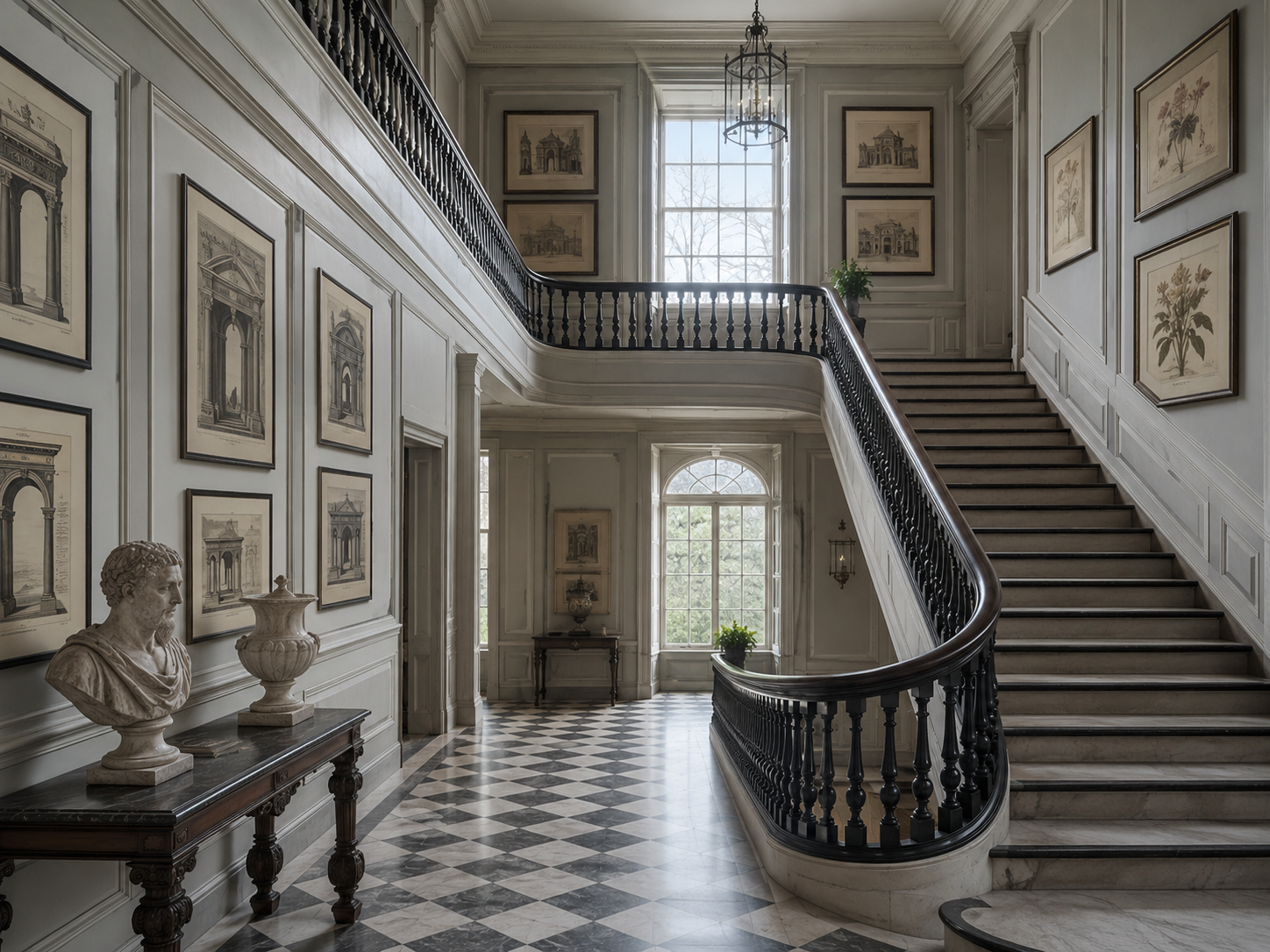
It lights the ceiling, which is the least interesting surface you own. It puts a hard top on every object in the room and a shadow underneath it — under the cornice, under the shelf, under the eye. It renders a room perfectly legible and entirely unlovely, in the manner of a stockroom, and it does this evenly, so that no part of the room is more worth being in than any other. That last is the real crime. A single high source abolishes the idea that a room has good places in it.
Six low sources do the opposite. They make an uneven room: a pool to read in, a warmer pool to talk in, a corner left deliberately unlit so the eye has somewhere to rest. The light stops being a utility and becomes a plan of how the room is meant to be used — which is, when you think about it, the same information a good floor plan carries, delivered at dusk instead of on paper.
Six is not a magic number. It is simply the count at which a room stops having a lit half and a dark half.
The working rules are three. Nothing above shoulder height when you are seated, except the fire, which is allowed to do as it likes. Three heights in play — table, chest, floor — because light at a single height is only a longer version of light at a single point. And every seat within arm's reach of a switch: a lamp you cannot turn on from the chair you are sitting in belongs to somebody else.
III. In defence of the flex
I have come to believe that most rooms end up lit from the ceiling for one reason, and the reason is not taste. It is a horror of visible cable. People will accept a bare bulb overhead and refuse a beautiful lamp on the far side of the room because getting power to it would mean a wire crossing four feet of floor, and a wire crossing four feet of floor is untidy, and untidiness is the only sin the modern interior recognises.
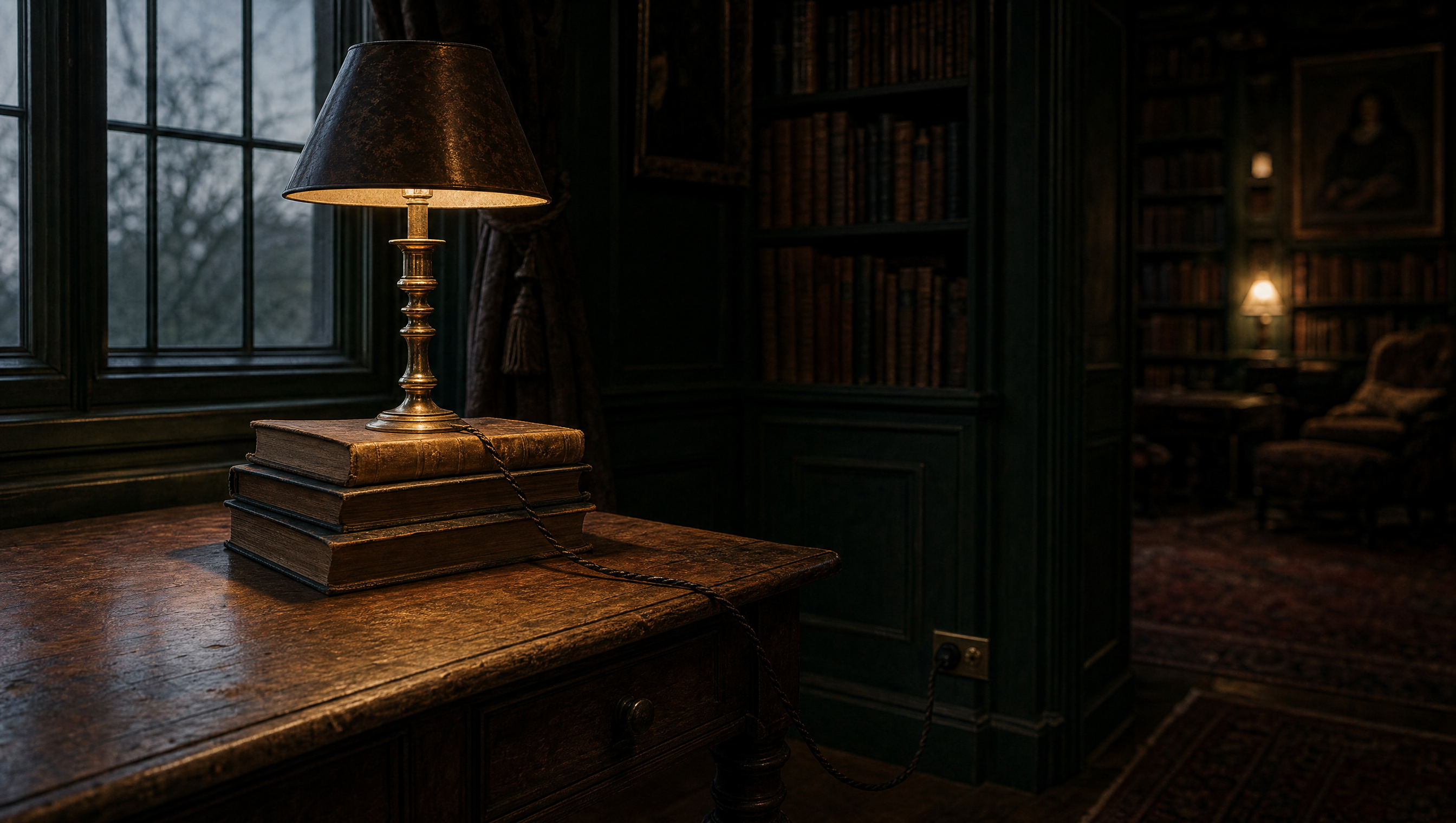
So let me be plain about it. Flex is not a flaw. Braided cloth flex, in a colour that agrees with the room, run the short way and dropped down the leg of the table it serves, is a piece of the furniture. What is a flaw is a wire stretched across a doorway, or four extension leads breeding behind a sofa, or the pale plastic cord that came with the lamp and has been permitted to stay.
Hide the wire and you will end up hiding the lamp. Then you are back at the ceiling, where you started.
The honest fix is duller and better: sockets where the furniture actually is. It took an electrician two days to put them there and it cost rather more than the lamps standing on top of them, and it remains the best money I have spent on this house. A room with sockets in the right places will be lit properly for the next fifty years by whoever lives in it, including the people who arrive after me and think I had no taste at all.
While we are being honest: I lived under a single bulb in a rented flat for four years and told myself I did not mind. I minded. I went to bed early for four years and thought it was the job.
IV. Doctrine, room by room
The drawing room. Six, and the fire. One to read by, at your shoulder, with a shade deep enough that you see the page and not the bulb. One behind you, so your book is not the brightest object in the county. One on the far side of the room, whose only job is to stop the far side of the room going out. One low on a bookcase, which is the cheapest way to make a wall look considered. Candles on the chimneypiece. Nothing overhead, ever, unless something has been dropped.
The study. Dark walls eat light, so the sources must be nearer and slightly more numerous, not brighter. This is the room where people lose their nerve, put in a bright ceiling fixture to compensate, and undo the whole effect they painted the room to get — which is the whole argument in defence of the dark study. Two lamps on the desk if it is a long desk. A picture light doing double duty. That is enough.
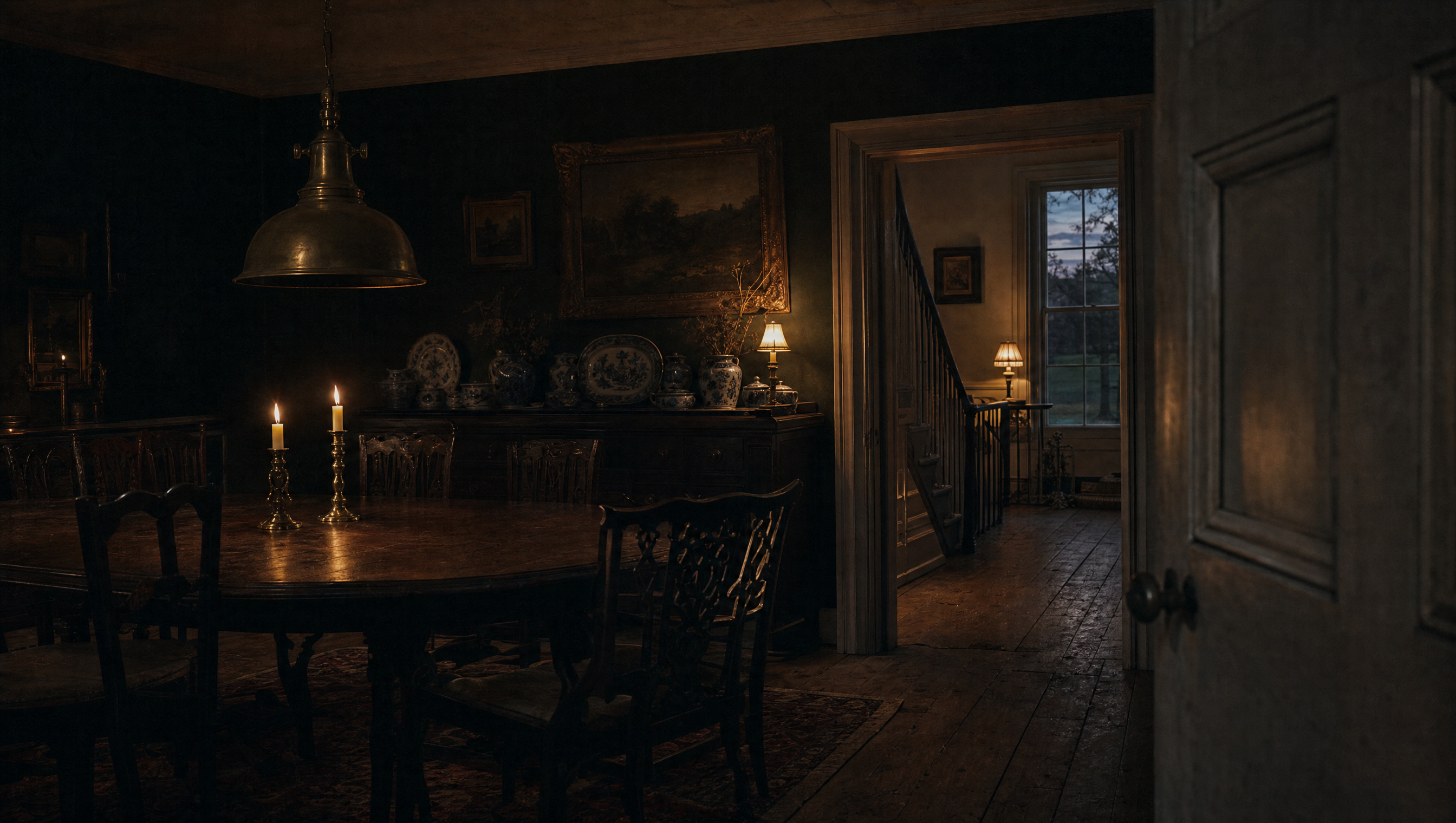
The dining room. Candles on the table, always, and one low lamp on the sideboard behind so that faces are lit from two directions and nobody looks embalmed. If you insist on a pendant over the table, hang it low — thirty inches above the wood, so it lights the cloth and not the diners — and dim it until it is quieter than the candles. A pendant that competes with a candle loses, and takes the evening with it.
Stairs and landings. The one place I concede the overhead entirely: stairs must be lit from above, because a light at the bottom of a flight throws the treads into shadow and that is how people fall. Concede it, then soften it with a small lamp at the turn, which is the light you will actually leave on.
The bedroom. Two lamps, both reachable lying down, both dim enough to read by without waking anyone. An overhead light in a bedroom is an alarm clock with a shade on it.
The kitchen. Here I fold, and I fold completely. You are handling knives and heat; you want real work light, bright and high and even, over the board and under the cupboards, and you want it whiter than anything else in the house. What you also want is a second circuit — one lamp on the dresser, one on the table — and the discipline to kill the work light at eight o'clock. A kitchen lit at midnight the way it was lit at midday is a kitchen nobody sits in.
V. The dusk walk
If you do one thing after reading this, do this one. Wait for the half hour when the windows have gone blue and the room has not yet been switched on, and walk through the house without touching a switch. You will find, without any effort, the two or three places you want to be — a chair by a window, the end of a table, the turn of a stair. Those are your lamps. Everything else is a fitting you inherited from a pipe.
Two mechanical notes, since they are where good intentions usually die. Keep the warmth consistent: one cold bulb in a room of warm ones is the single mistake that makes an expensive room look cheap, and it is always the bulb somebody replaced in a hurry. And put the switches where the hands are — inline on the flex, at the foot, on the lamp itself — because a lighting scheme that requires you to stand up is a lighting scheme you will stop using by November.
None of this is a new idea. It is the oldest idea in the English room, and the best demonstration of it I know is Sir John Soane's on a candlelit evening, where a house that is merely a fine collection by day becomes, at dusk, a set of decisions — because the light has come down off the ceiling and gone to stand next to the things that matter. Soane did that with candles and mirrors and no choice in the matter. We have every choice in the matter, and we keep choosing the pipe.
The brass fitting overhead stays, incidentally — original, handsome unlit, and switched on four times in as many years, half of them to find an earring. Which raises a question I have not settled: how much of a house is kept on for the handful of evenings it is actually needed, and how much of that is sentiment wearing the coat of practicality?

Bea is a curator and writer, and keeps the Museum Directory. Arguments in favour of the ceiling are read carefully and rarely won.
Items marked † are affiliate links. The Manor earns a small commission if you buy through them, at no cost to you, and nothing is listed here that is not already in this house.