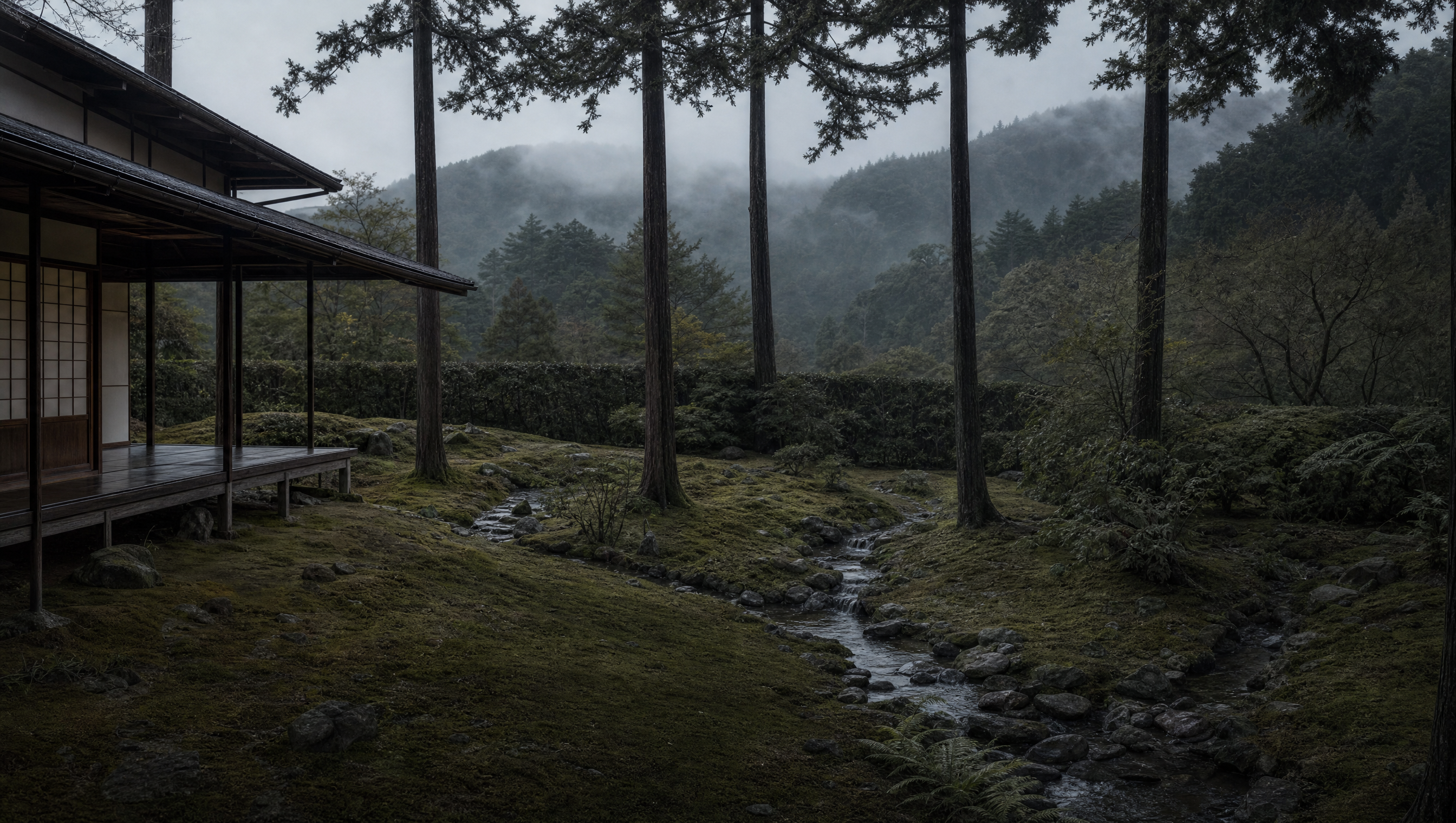
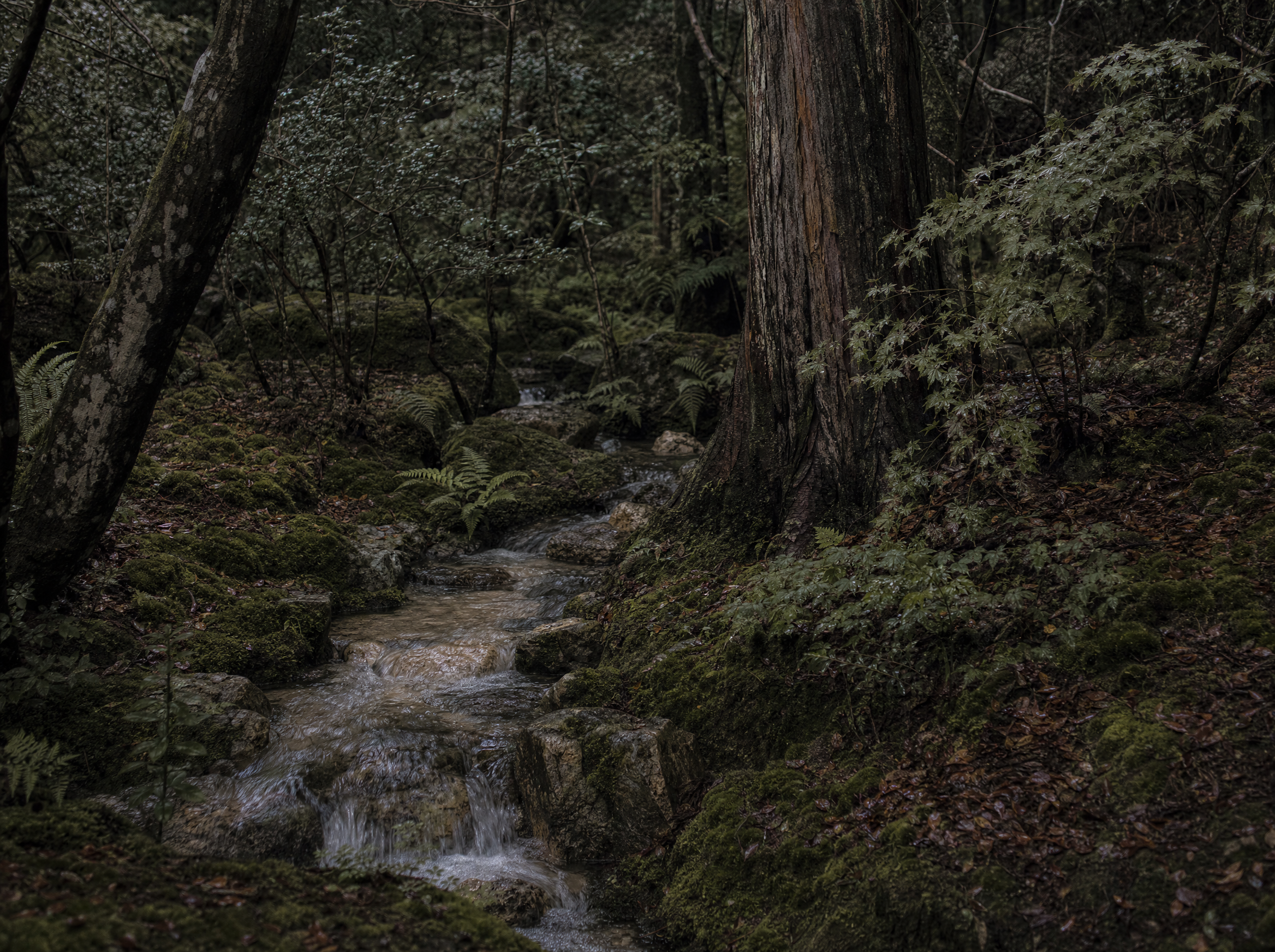
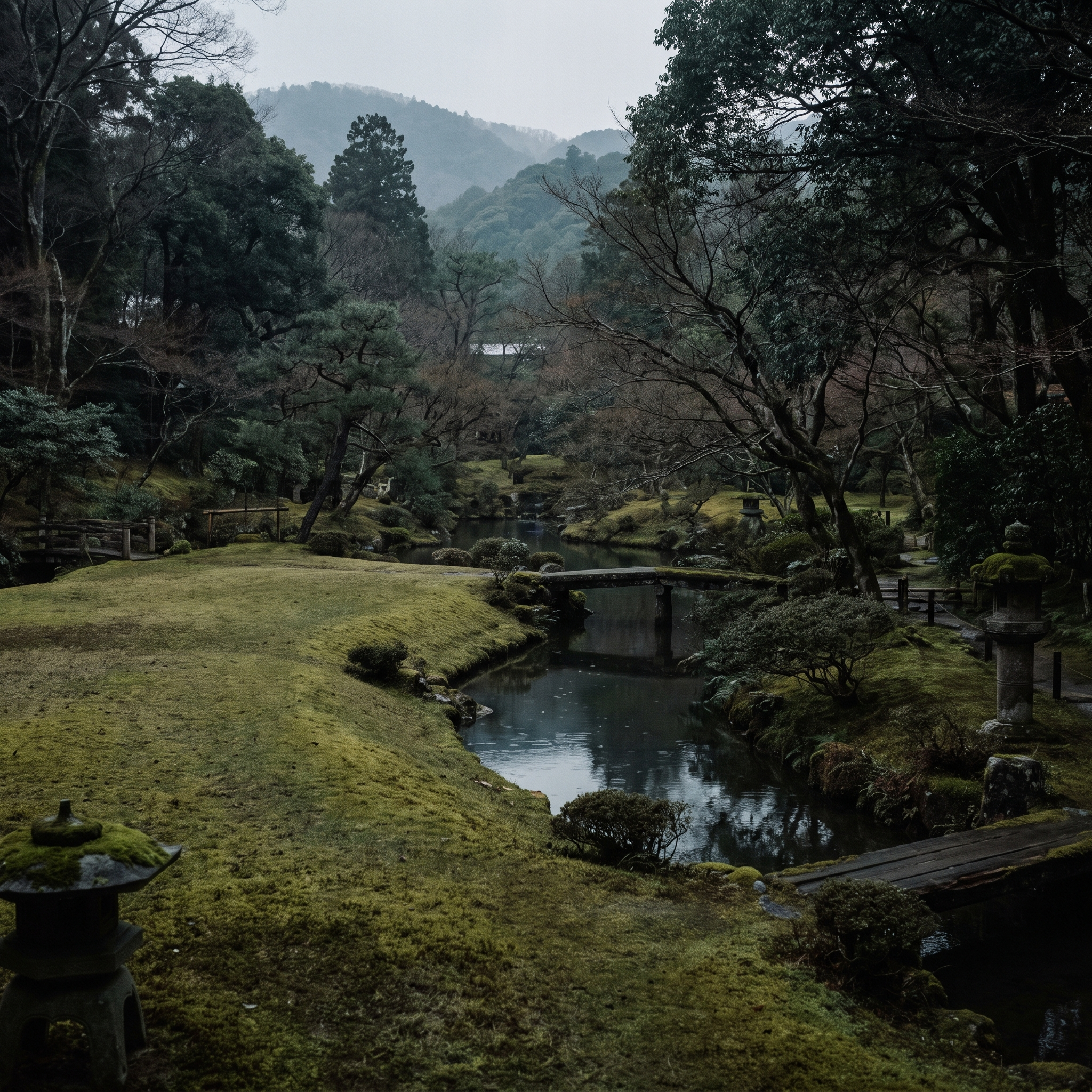
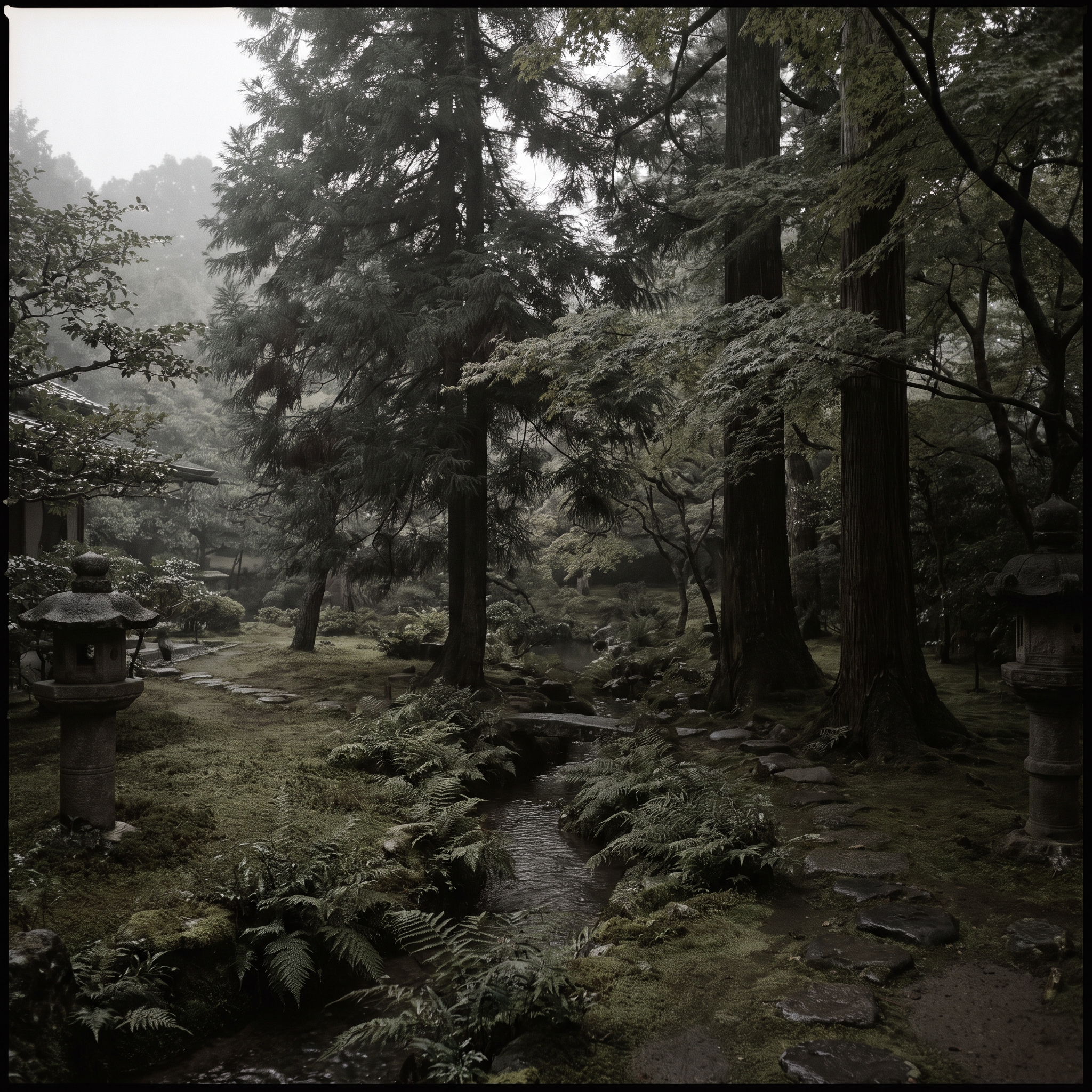
Yamagata Aritomo built Murin-an between 1894 and 1896, at the foot of the Higashiyama, and had the garden made by Ogawa Jihei the seventh — Ueji — working to his instructions. What the two of them did was refuse the older symbolic grammar. No islands standing for paradise, no stones standing for cranes. Instead: an open lawn, three shallow streams running fast over pale gravel, some thirty firs, and water diverted in from the Lake Biwa Canal, which had only just been dug. Yamagata's own account of it says plainly that the mountains at the centre of this garden are the Higashiyama that rise in front of it. The hedge is cut low, and everything inside is arranged so the borrowed slope reads as the far end of the property.
There are three buildings, and they do not agree with one another, which is the second pleasure of the place. A wooden main house that opens completely onto the garden. A tea house. And a small two-storey Western annexe in brick, which is where, on 21 April 1903, Yamagata sat down with Itō Hirobumi, the prime minister Katsura Tarō and the foreign minister Komura Jutarō to settle a policy towards Russia. A war followed. The upper room is very small, and the fact that a decision of that weight was taken in a room that size, looking out at that view, is the thing I have never quite got over.
It was designated a Place of Scenic Beauty in 1951, and it is the only one of the Nanzen-ji villas open to the public all year. Entry is by hourly booking with a small ceiling on numbers, which is the best thing anyone has done to a famous garden this century — book the first slot of the day, in rain if you can arrange it, and you will have the lawn to yourself while it steams. Take the matcha in the main house and sit on the floor at the open edge. Sixty minutes is plenty. Ninety is better, and I have never once wanted to leave at the end of one.
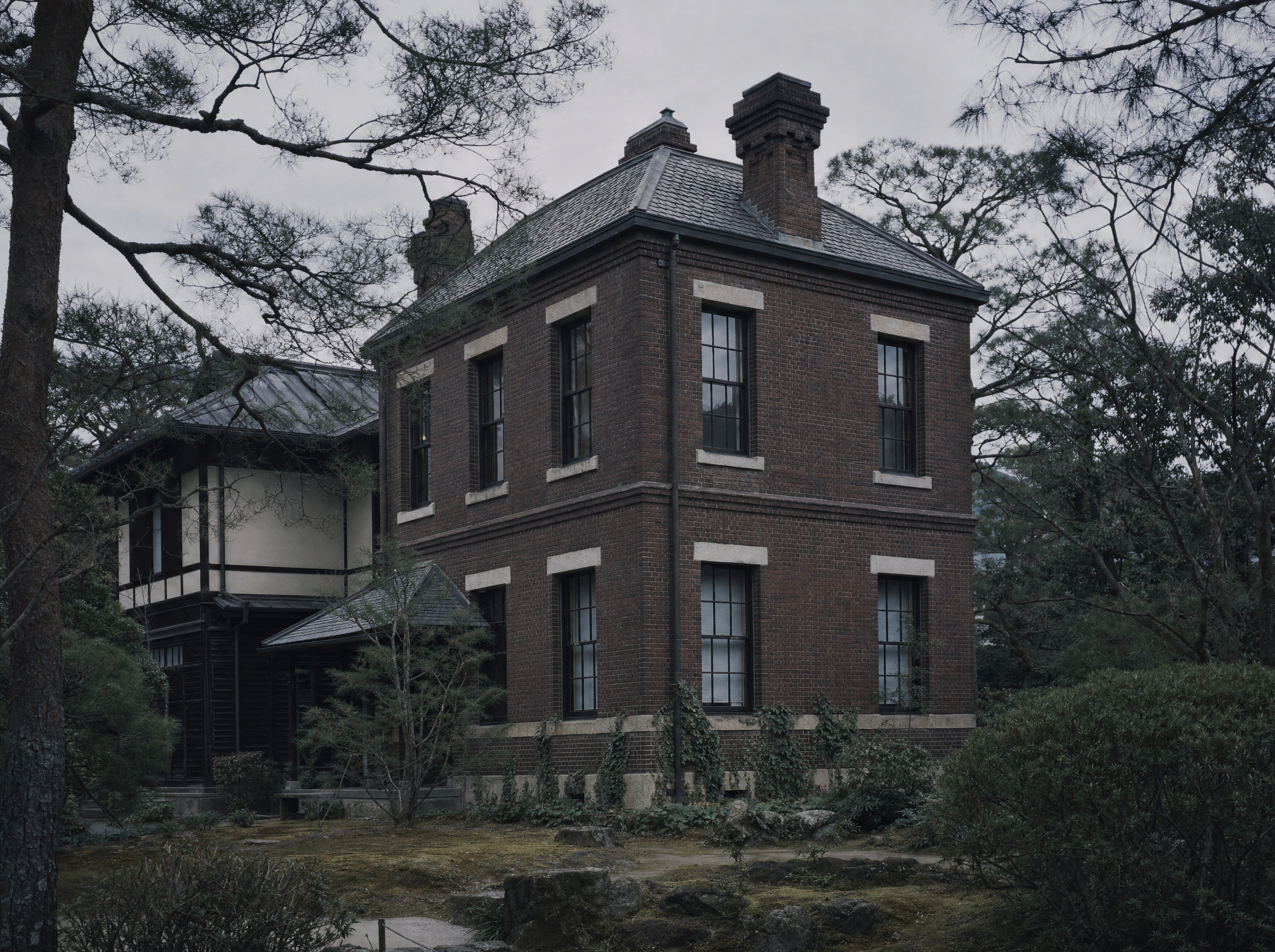
Four men, one small upstairs room, and a war on the other side of the decision.
On 21 April 1903, Yamagata Aritomo, Itō Hirobumi, Katsura Tarō and Komura Jutarō met in the upper room of the brick annexe to agree a line on Russia. The Russo-Japanese War began the following February. The room is preserved; the conference is what most Japanese visitors come knowing, and most foreign visitors leave without noticing.
I do not think the garden is innocent of it. The whole design is about command of a view — clip the hedge, keep the lawn open, and a mountain you do not own becomes yours to look at. It is a beautiful idea and it is also, if you turn it very slightly, a habit of mind.
Sit on the boards of the main house afterwards with the tea. The water is loud, the mountain is doing its work, and the annexe is behind your left shoulder the entire time.