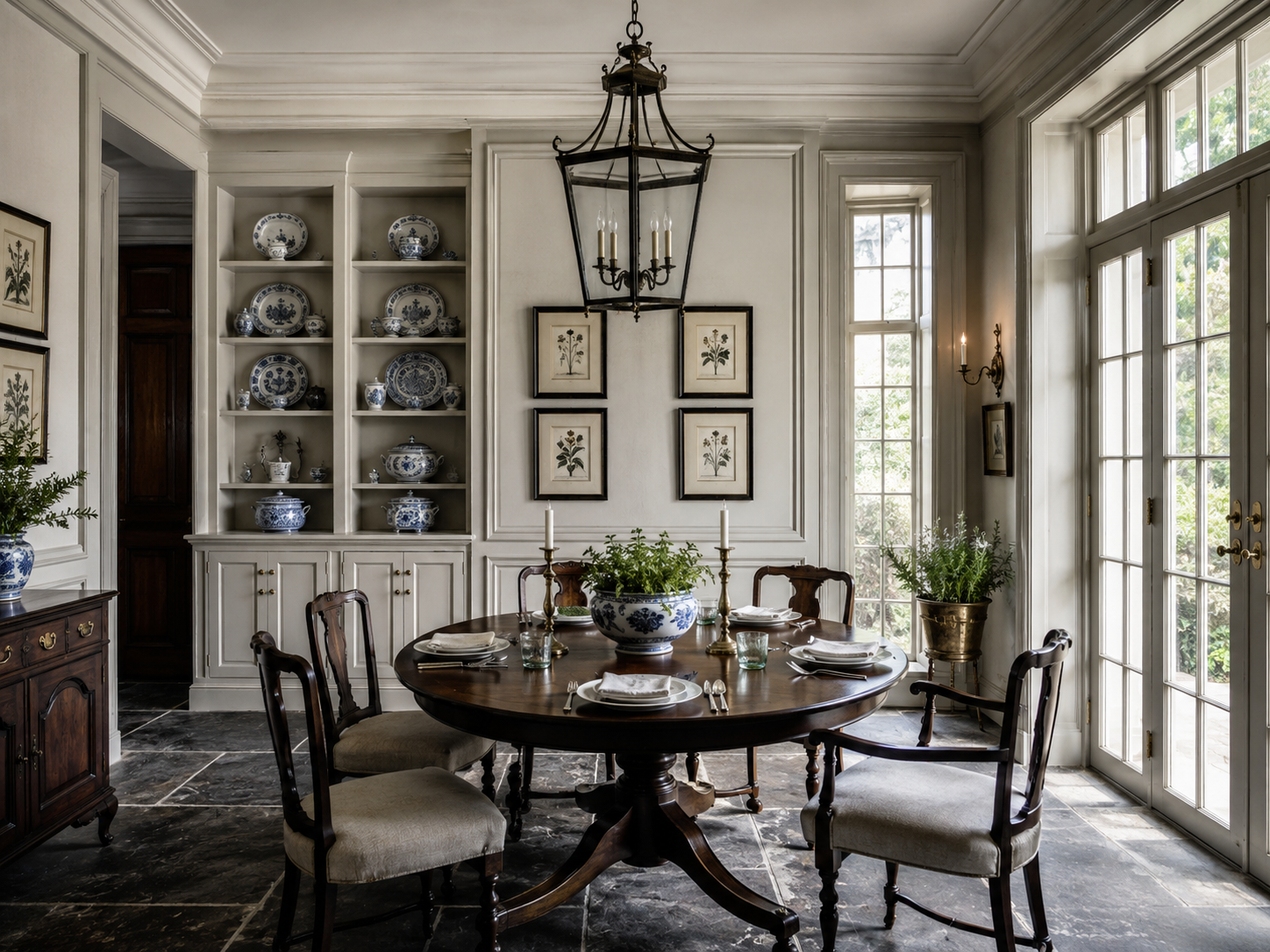
There is a moment, in a certain kind of house, when the blue and white stops being a collection and becomes a condition. You know it when you see it. Plates climb the wall in a rising fan. There are three teapots and no tea. Somebody has bought a plate rack for the plates that would not fit on the other plate rack. The room has stopped being a dining room and become a shop that never opens, and the terrible thing is that every single piece in it was, on its own, quite nice.
I have about sixty pieces of English blue transferware. That is more than most people and considerably fewer than I have wanted, on several specific Saturdays, to own. What follows is how I keep it from tipping — what I hunt, what I put down and walk away from, and the two rules I have never once broken, mostly because I have seen what happens to the people who do.
I. What you are actually buying
Underglaze transfer printing was perfected at Spode in Stoke-on-Trent in about 1784, and it is worth understanding the process, because the process is what you are looking at when you hold a plate up to a window. A design is engraved into a copper plate. The engraving is inked with a cobalt compound, printed onto gummed tissue, and the tissue is laid onto the biscuit-fired ware and rubbed down by hand. Then glaze, then a second firing, which sinks the print under the surface where a hundred and fifty years of knives cannot reach it.
The economics were brutal and are the whole reason any of this exists in quantity: two printers could decorate as much ware as a hundred painters. This was industry, not artistry. It was the first time an ordinary household could own a matched service with a picture on it, and the pictures were shamelessly aspirational — Italian ruins, Chinese pavilions, other people's abbeys. The Willow pattern, which appeared in the 1790s and which everyone thinks is Chinese, is an English invention with an English legend bolted on afterwards to explain it.
II. The two rules
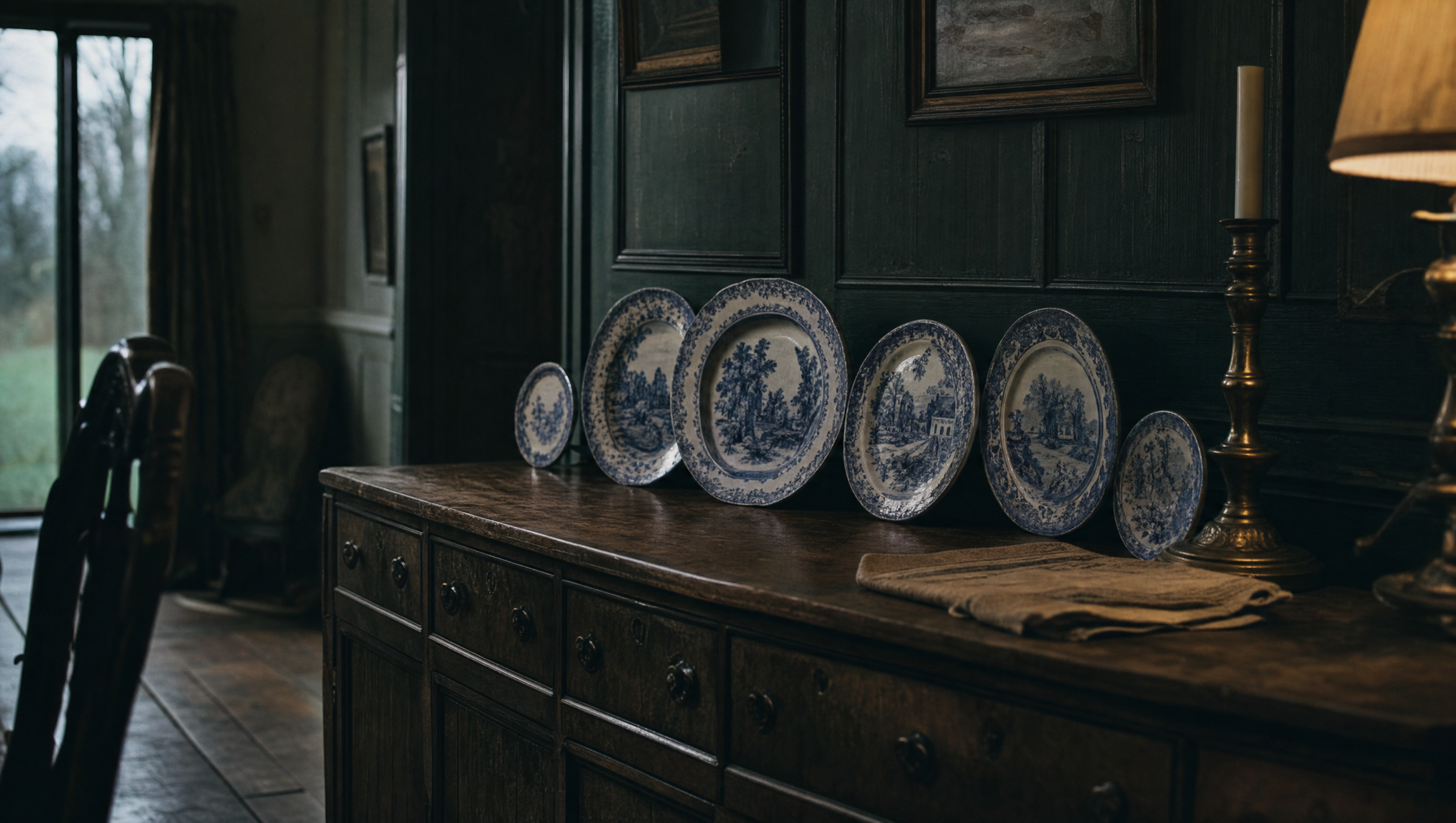
Nothing comes into this house that cannot hold dinner. Not the miniature. Not the sweet little lidded thing whose lid is missing. Not the plate that is too fine to eat from, which is a category invented by people who are about to acquire eleven of them. If I would not put a lamb chop on it in front of a guest, it stays on the stall. This single rule has removed perhaps four-fifths of everything I have ever been tempted by, and it removes exactly the four-fifths that turns a room into a display case.
Nothing goes on the wall. China on a wall is a decorating gesture; china on furniture is a household. The moment plates go up, they stop being objects you use and become a pattern you have made out of objects, and a pattern demands to be completed — which is how a fan of six becomes a fan of fourteen and then a second fan over the door. Mine live on one dresser and in one cupboard, propped, stacked, and taken down four or five times a week.
Density is not the enemy. Density with no argument behind it is.
I should be honest that the case for piling things up has been made better than I could make it, and made a few streets from Holborn. Soane crammed three houses to the ceiling and it works, because every object is doing a job in a system he could have explained to you at length. That is the licence, and it is not a licence most of us have earned. Absent the system, quantity is just noise you dust.
III. What to hunt
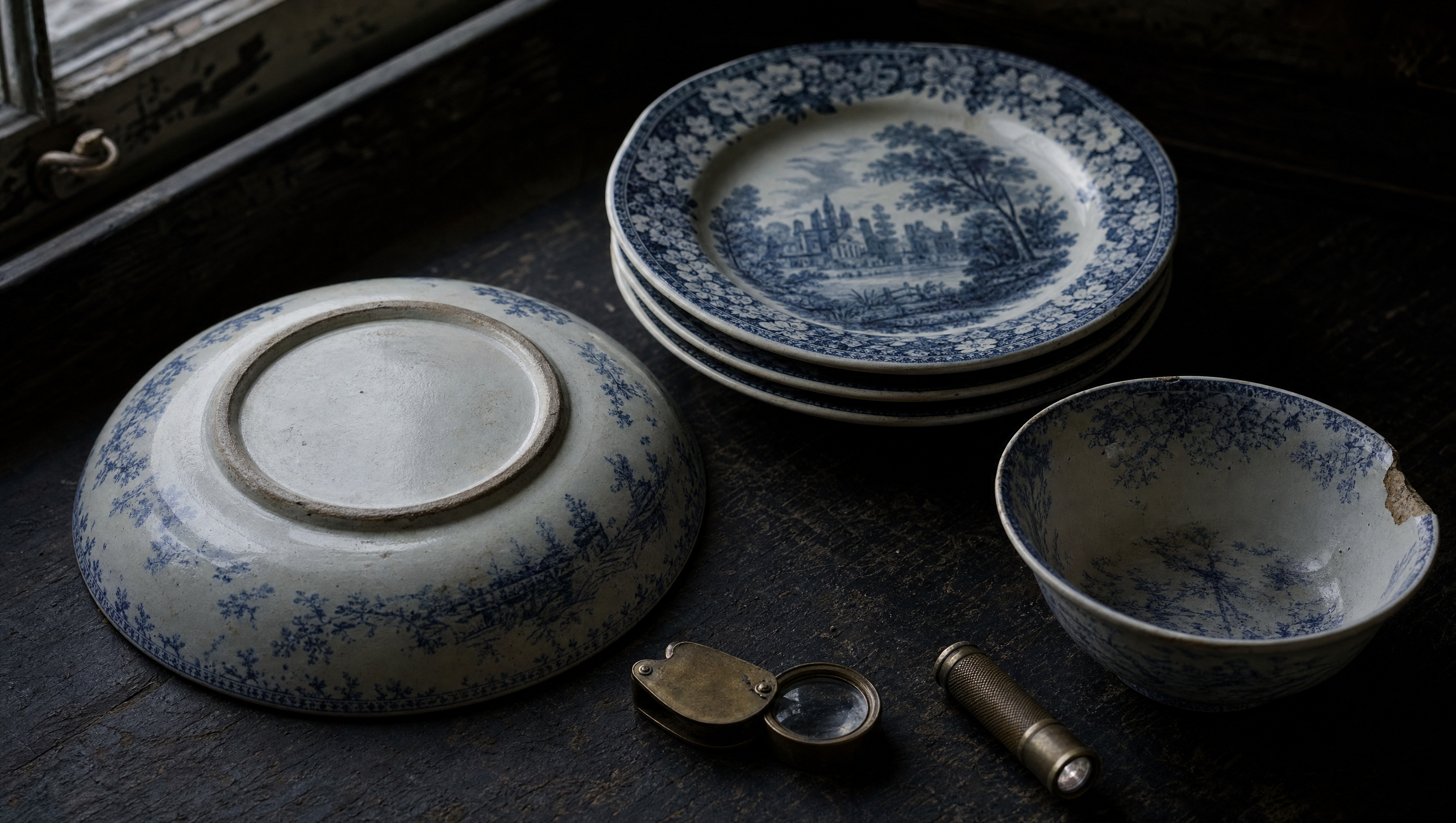
Turn it over first. Always. The front is what the seller priced; the back is what you are buying. An unglazed foot rim with soft, uneven wear is a good sign, because it means the piece has spent a century being slid across tables rather than sitting in a cabinet being admired. Look at how the transfer meets itself around the rim: on early ware the engraver's joins are visible, slightly mismatched, sometimes patched by hand. Those seams are the difference between a printed object and a printed-out one.
Marks will date it faster than instinct. A diamond-shaped registry mark puts the design between 1842 and 1883; from 1884 the diamond gives way to a registered number, printed as Rd No and a figure. The word England on its own generally means it was made for export after the McKinley tariff, in force from 1891 — and Made in England usually means later still, the 1920s and after. None of which tells you whether a thing is good. It tells you whether the dealer's label is.
Then: hunt shapes, not sets. Serving dishes, drainers, sauce tureens, the deep oval platters nobody has a use for and everybody wants once they have one. Odd forms survive in smaller numbers because they were used less and broken more, and they are the pieces that make a table look like a house rather than a catalogue. A run of twelve matching dinner plates is a purchase. One meat dish with a spectacular border is a decision.
IV. What to walk past
Hairlines. Run a thumbnail across the back and hold the piece to a light — a crack you can barely see will still take somewhere between a third and a half of the value off, and more to the point it will open. Crazing is a different matter entirely and gets confused with damage far too often. On Victorian earthenware fine, even crazing is simply what a soft glaze does over a century, and I regard it as a credential. Brown staining in the crazing, on the other hand, is old tea and worse, and it does not come out however confidently the internet tells you it will.
Walk past the second colourway. Transferware was printed in brown, mulberry, puce, green and black as well as blue, and every one of those is handsome on its own terms. Buy two of them and you no longer have a collection, you have a sample card. Pick a colour and be dull about it for a decade. The restraint is what makes a shelf look considered rather than accumulated, and it is also the only thing standing between you and the rising fan of plates.
And walk past completeness. The Transferware Collectors Club database has passed twenty thousand recorded patterns and is still growing. You cannot finish this. Anyone who has quietly accepted that buys better, because they stop buying to close gaps and start buying because a thing is beautiful in the hand at eleven o'clock on a wet morning.
V. The rules I break
I said I would not buy damaged pieces, and then I bought a chipped slop bowl with a fern border because the print was so fine it looked like frost, and it is in Plate II, unrepentant. I said one pattern family and then acquired a second because the border rhymed. I said I would stop at fifty. I have also bought something at auction that I had not properly examined, which is a sin against my own advice and one I have written about elsewhere.
The two real rules absorb all of that, which is why they are the two real rules. Everything in this house can hold dinner, so nothing is precious. Nothing is on the wall, so nothing has to be arranged. Between those two fences you can be as greedy and as sentimental as you like and the room will hold, because knowing when to stop is not really about how much you own. It is about deciding, in advance, where the collection is not allowed to go.
We ate off five of these last night and one is now in the sink with a chip in the rim that was not there in the spring. I am not going to pretend that does not sting. But an object that cannot be lost is not really being kept, only stored, and I have read enough houses to know which of those a room can feel. The dresser is fuller than it was in January. It is also, still, one dresser.

Bea is a curator and writer, and keeps the Museum Directory. Attributions offered for the fern-bordered bowl are welcomed and will be argued with.
Nothing in this piece is a purchase recommendation with a price attached, because prices for transferware move with condition and the weather at the fair. Look, turn it over, and pay what it is worth to you.