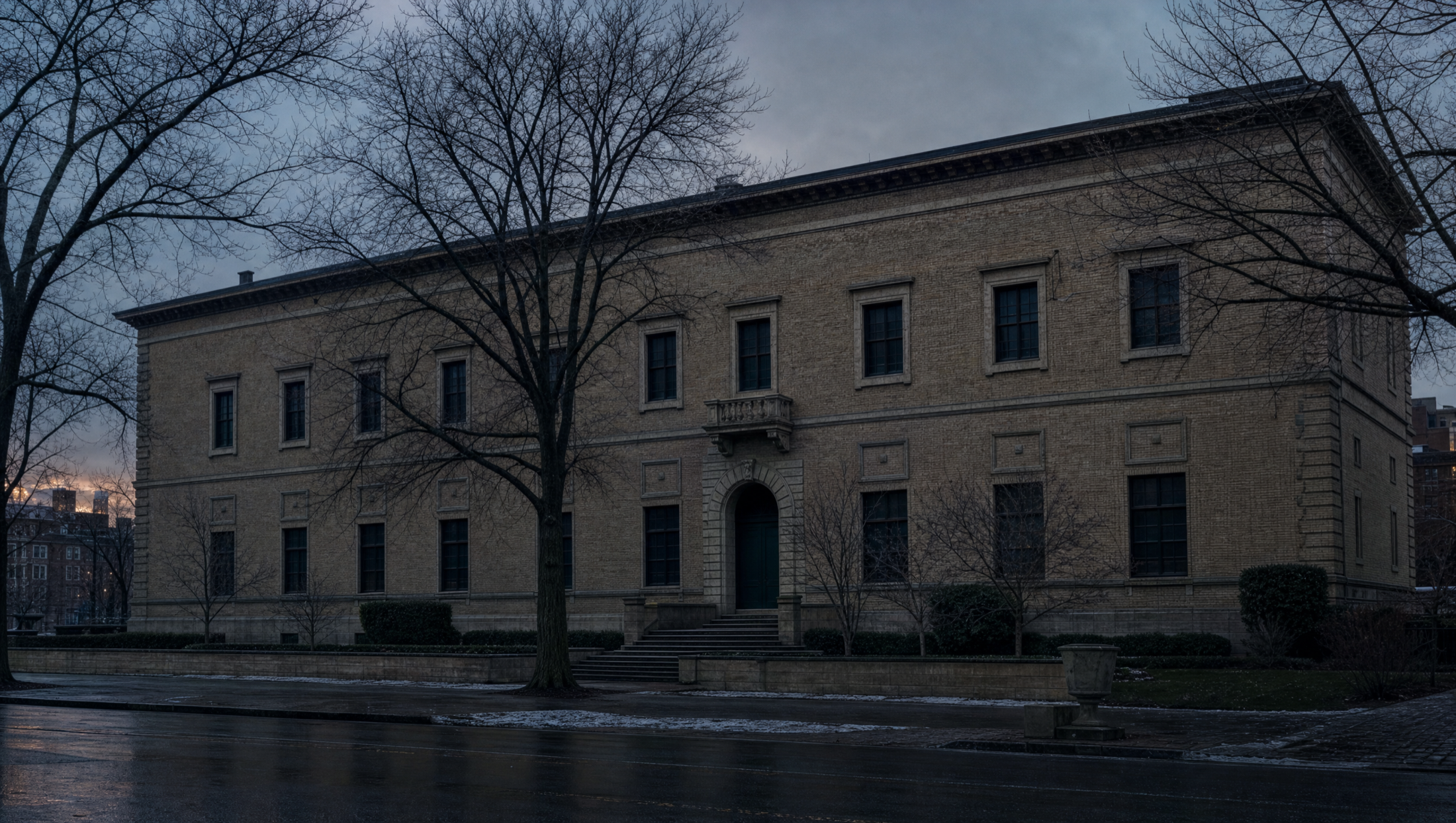
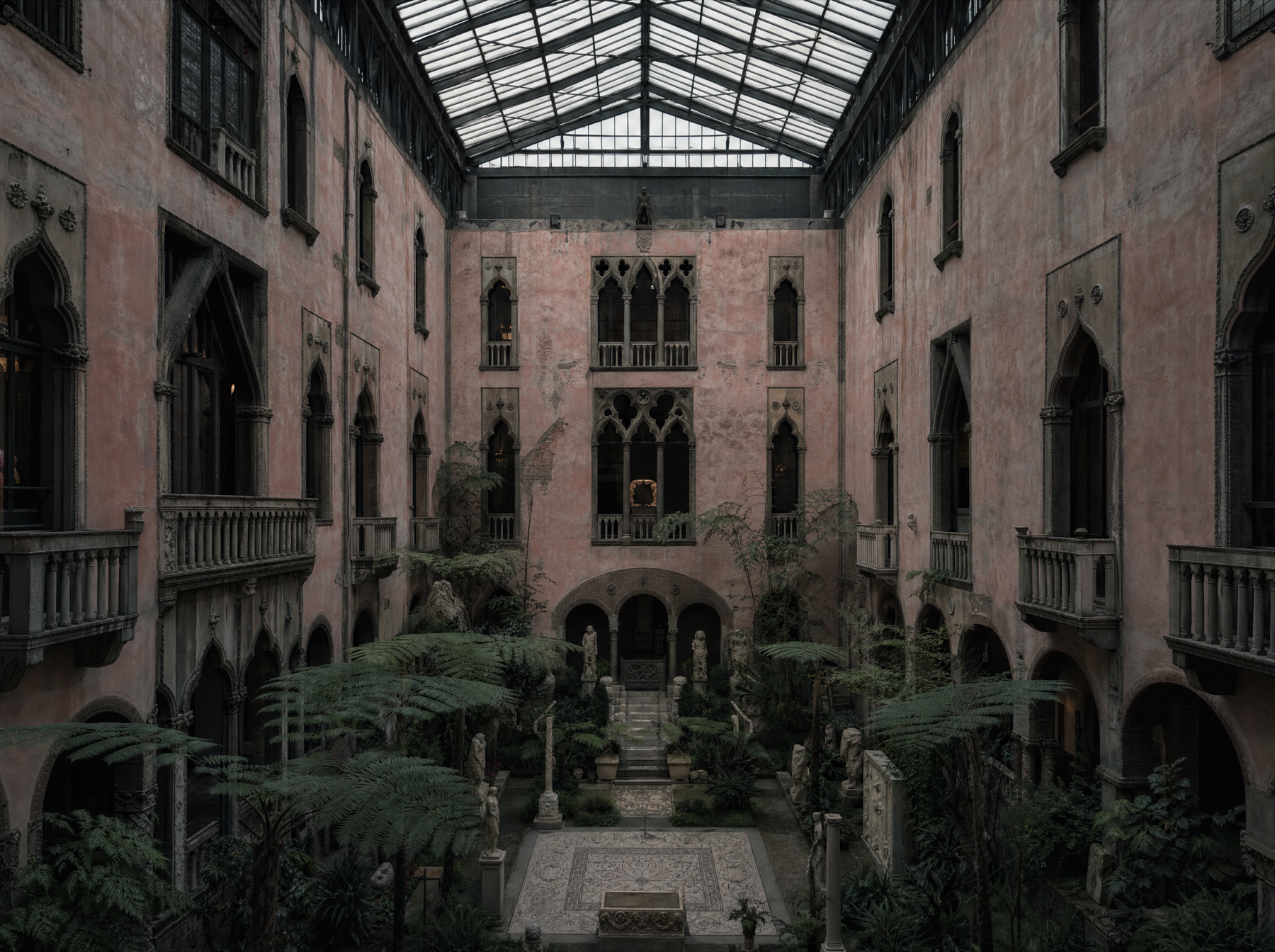
The outside tells you nothing, and I have come to think that is the first instruction. Willard Sears raised the building between 1899 and 1901 to Isabella Stewart Gardner's specification, and what he raised was a Venetian palace turned inside out: the arcaded windows and carved fragments she had shipped from Venice face not the street but the courtyard, four storeys of them, under a glass roof. From Evans Way it reads as a large plain box. Step through and the whole architecture is suddenly on the wrong side of the wall, looking in at a garden. I stood in that courtyard in January with my coat still buttoned and did not move for some time.
She opened it on the first day of 1903 and lived upstairs until she died in 1924, and her will requires that the arrangement stay as she left it. This is the thing people underestimate. It is not a museum with a strong hang; it is one woman's sentence, still being spoken, with almost no labels to interrupt her. A Whistler beside a bit of Roman marble beside a chair, because she thought they answered one another. You will not be told why. Sometimes she was showing off, and sometimes she was right, and working out which is the entire pleasure of the place.
Go on a weekday morning in deep winter. The courtyard is planted and warm and lit like an aquarium while Boston does its worst outside, and the contrast is genuinely half of it — I have been in April, when the nasturtiums hang down from the balconies and everyone in the city comes to see them, and it is beautiful and it is crowded and it is not the same building. Renzo Piano's glass wing, added in 2012, is where you now come in; treat it as a decompression chamber, not the visit. And do not go looking for the famous pictures. Several of them are not there.
NOT PHOTOGRAPHED 032c
PLATE PENDING 032d
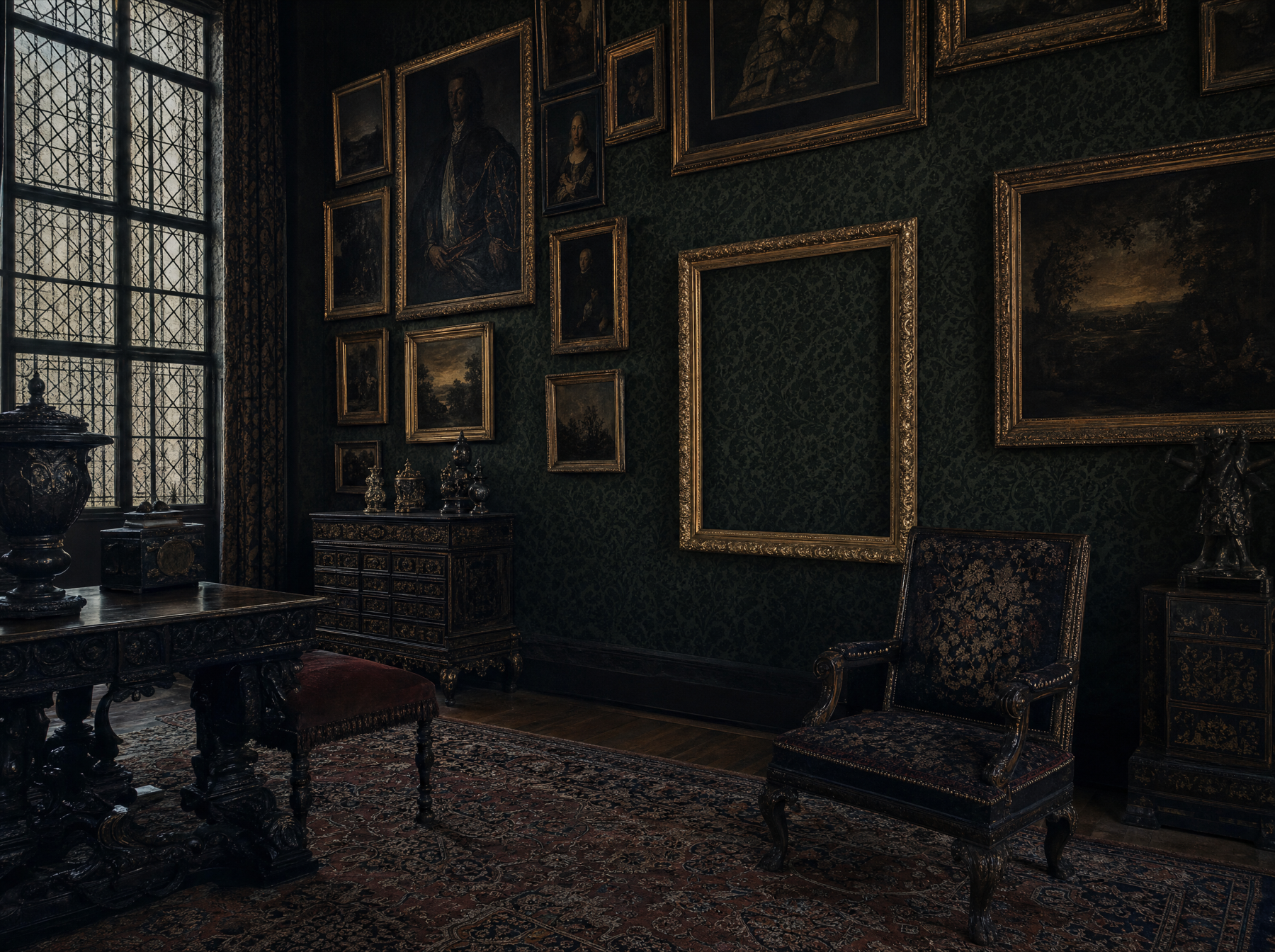
The frames were left hanging, which is the most eloquent thing anyone here has ever done.
In the early hours of 18 March 1990 two men in police uniform were let in at the side door, tied up the guards, and left eighty-one minutes later with thirteen works — Vermeer's The Concert, two Rembrandts and a Rembrandt self-portrait etching, Flinck's Landscape with an Obelisk, a Chinese bronze beaker, works by Manet and Degas. Nothing has been recovered. The reward stands at ten million dollars.
Because Gardner's will forbids rearranging what she arranged, the empty frames stayed on the walls. That is a legal accident which became the truest curatorial decision in America. Every other museum would have closed the gap and moved on. Here the hole is kept at the exact height she hung it, in the exact fabric, and you cannot look at the Dutch Room without being asked to hold two things at once.
I did not expect it to work on me and it did. Stand there a while. Then go back down to the courtyard, which has lost nothing, and let it put you back together before you go out into the Fenway.